Why I Use the Nord Grand 2: Aesthetic Arguments Around Keyboard Simulation
Author's Note: The keyboard is an entirely different instrument from the piano. Obviously. They serve different purposes - synthesizers and emulators of pianos and organs and such - than a real instrument. However, working pianists must use keyboards in most live scenarios, simply due to the extreme impracticalities of hauling a real piano around. This letter is not to say there aren’t fantastic pianists who use flat keyboard/x-stand setups. Most do for practicality. I am making an argument about aesthetics and their importance.
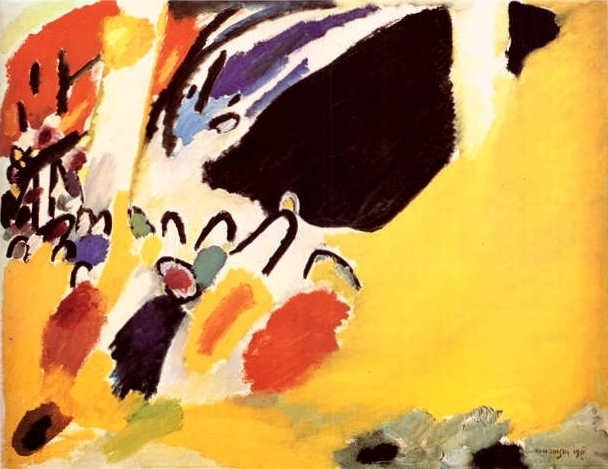
Kandinsky paints a powerful, symbolic piano in this description of his meeting with Arnold Schoenberg
Image credit: MoMA
This is a letter to pianists, those who consider themselves a pianist first and a keyboardist second. Others need not apply.
Imagine a pianist pounding the keys of a 73-key plastic keybed in a primary color plastic chassis with a million buttons, levers, beeping lights, and doo-dads, teetering precariously on an x-stand that wobbles with every chord. There is a large name brand on the back. We see his legs fumble around for his plastic sustain pedal. The pedal’s black cable, along with the black power cable for the keyboard, has created a visual spider web against the black x-stand, creating a warped tic-tac-toe grid that seems to frame the pianist’s poorly-hemmed pants-crotch as they sit on a plastic imitation fold-up piano bench.
The pianist in our scenario is automatically fighting an uphill battle with my attention - it’s a hard sight to swallow visually and emotionally. I imagine a large man-child pounding his toy. His instrument and set-up are merely the easiest means to thrust himself into the spotlight. The piano is only a part of his art so far as it is the excuse to get him onto a stage.
For any pianist who cares about the pursuit of the art of being a pianist-and the entire magnetic field of musicking you are responsible for maintaining during performance-the above scenario is absolutely unacceptable.
There are three practical points at which the magical mystery of a piano simulation is ruined for me: Shell, Stand, and Branding.
SHELL
All real pianos and real keyboard instruments (Rhodes, Wurlitzer, etc.) have some sort of wall at the back of the keybed, which is usually one of the walls for the shell housing of the mechanics of the instrument, usually hammer-related. The lack of any sort of shell apparatus on most keyboards is uncanny to me. You are not providing me anything to believe in. When you pound the keys, I see you triggering a contact pad to 127 velocity. A pianist playing a keyboard with no shell looks like a button-pusher to me.
We were never meant to have a clear line of sight to the pianist's hands from the opposite side of a piano. It has never existed. This is a fundamental archetype of piano. It is something not often put into words, but it is noticed and known by all. When the audience can see your fingernails as you play while standing on the opposite side of your instrument, you have ruined their suspension of disbelief. You are no longer a pianist; you are a keyboardist.
The ‘shell’ of the Nord Grand 2 I use gives me something to believe in. It gives the audience something to believe in. When I pound the keys, I daydream about the clash of hammer against string, and the shell provides a home for my dreams, and thus I am given a conviction that can only be achieved when faith and dreams have a physical, secret space to exist. My fingers have the anonymity of dancing behind the wall of the shell, and those who wish to join my secret little world must come to my side of the stage.
STAND
The x-stand suffers similar issues to the lack of shell. It makes the instrument you are playing look light and inconsequential. The piano is a BIG instrument. It is visually big. It is sonically big. It can dominate every single frequency range of a song. It is impossible for this much importance to be held up by an x-stand. A piano on an x-stand is an upside-down Pyramid of Giza. A bodybuilder with chicken-legs.
I use a stand with four legs. Four legs are physically and symbolically stable. Real piano/keyboard instruments have three or four legs. We have four limbs. Every large land mammal is born with four limbs. You can play a small, flat keyboard like a rabbit. There is a place for that. I want to play like an elephant. A pianist on a flat x-stand setup can try and match my elephant thumps. It may even be sonically identical. Even if it is, I don’t believe them.
BRANDING
The tertiary point of this argument is large brand logos. The flat keyboard already leaves no mystery as to the nature of your piano simulation. The large white ‘YAMAHA’, ‘ROLAND’, or whichever it is in factory typeface acrylic print on the back of your keyboard degrades the whole experience even further. How could I hope to believe your simulation when I see the name of the maker of your toy screaming at me from the stage? Did you get a buy-one-get-one Yamaha dirt bike or boat motor with your purchase? When you go to see a movie, does the screen have a constant watermark that screams ‘JOHN DOE MOVIE SCREEN COMPANY, LLC.’?
On most real piano instruments there is a classic, understated logo facing the keys and on the side. Some even do not have a logo on the side. The Wurlitzer and the Rhodes have logos on the back, but they are such beloved classic typefaces that have been in the canon long enough to have become symbols that transcend brand text - they are part of the instrument in the way a low-effort keyboard logo will never be.
The culture around the Nord logo is an interesting middle ground, and may merit further discussion. The Nord logo, and by extension the Nord Red have become symbols associated with legitimacy, cost, and the ‘industry standard’. I personally cover my backside Nord logos with tape.
FINAL THOUGHTS
Flat keyboard people can absolutely use a piano shell and four-leg stand and solve every issue I have brought up. Hide all those doo-dads and blinking thing-a-ma-bobs and create a secret space for our imaginations to run wild. Allow that space to take you as far into fantasy as it takes us.
We live in a world of simulation. I don’t mean that in the we-live-in-a-simulation crackpot nonsense, but in the sense that humans have used technology to simulate experience for as long as human history remembers. We simulate pain, pleasure, rest, excitement, music, dance, whatever you can think of through technology. As pianists, we cannot avoid having to simulate our instrument. We, however, can avoid losing control over the narrative we present through aesthetic choices.
Yes, the Nord Grand 2 is heavy, and so are keyboard shells. Get a cart, get a dolly. Don’t be lazy.
We are already losing so much of the magic of music to the woos of convenience. It may not seem like a big deal, but give them an inch and they will take a mile.
Symbols are important, and we are all walking symbols of what we believe in.
03/12/2026